Endoscopic Spine Surgery – The Latest Revolution in Spine Care
Q. Has spine surgery changed over the years?
Yes. Spine surgery has evolved tremendously over the past few decades.
First Generation – Open Spine Surgery:
Large incisions with extensive muscle dissection. Although effective, patients often experienced more blood loss, greater postoperative pain, and a longer recovery period.
Second Generation – Microscopic Spine Surgery:
The operating microscope brought significant improvements in magnification and precision, allowing surgeons to perform procedures through smaller incisions while preserving more normal tissue.
Third Generation – Unilateral Biportal Endoscopic (UBE) Spine Surgery:
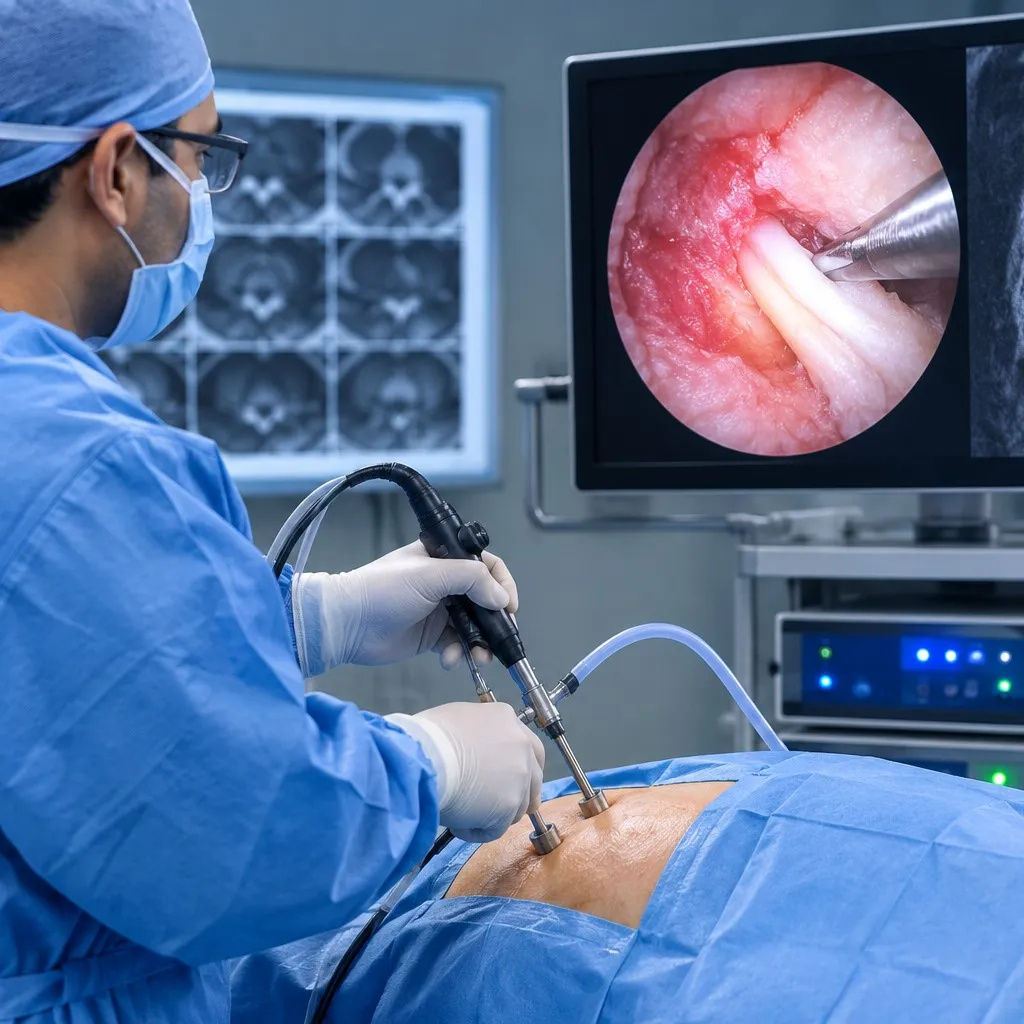
UBE is one of the latest and most advanced minimally invasive spine surgery techniques. It uses two tiny portals—one for a high-definition endoscope and one for surgical instruments. This provides exceptional magnification and illumination, allowing the surgeon to clearly visualize nerves, discs, ligaments, muscles, and blood vessels throughout the operation.
Q. Why is Endoscopic Spine Surgery considered one of the most precise techniques?
Unlike conventional surgery, UBE offers continuous high-definition visualization of the surgical field. Every important tissue is seen clearly, enabling the surgeon to remove only the diseased tissue while preserving healthy muscles, ligaments, joints, and bone. This precision contributes to safer surgery in appropriately selected patients and helps minimize tissue trauma. ([DOAJ][1])
Q. What are the benefits of Endoscopic Spine Surgery?
Patients may benefit from:
✅ Incisions usually less than 1 cm
✅ Minimal muscle injury
✅ Less blood loss
✅ Reduced postoperative pain
✅ Earlier walking after surgery
✅ Shorter hospital stay
✅ Faster return to work and daily activities
✅ Excellent cosmetic results
Several systematic reviews have shown that endoscopic spine surgery provides outcomes comparable to conventional surgery while reducing surgical trauma and promoting faster recovery in suitable patients. ([DOAJ][1])
Q. Which spine problems can be treated with Endoscopic Spine Surgery?
• Slipped Disc (Lumbar Disc Herniation)
• Sciatica
• Lumbar Canal Stenosis
• Cervical Disc Prolapse (selected cases)
• Recurrent Disc Herniation
• Degenerative Spine Disorders
Q. Who should perform Endoscopic Spine Surgery?
Endoscopic spine surgery requires specialised fellowship training and expertise.
Dr. Bhushan Meshram, Consultant Neurosurgeon & Endoscopic Spine Surgeon, offers advanced Unilateral Biportal Endoscopic (UBE) Spine Surgery for patients from Lalbaug, Byculla, Chinchpokli, Curry Road, Peddar Road, Worli, Mumbai Central, Dadar, Parel, Lower Parel, and South Mumbai.
Whether you are suffering from slipped disc, sciatica, lumbar canal stenosis, cervical disc disease, back pain, or leg pain, advanced minimally invasive spine surgery may help you recover faster with less tissue damage.
References
1. Dash A, Patil KR, Kancharla AR, Meshram BP, Jamoria RR, Prahallad AC, et al. Optimizing Lumbar Interbody Fusion: A Technical Note on Biportal Endoscopic Transforaminal Lumbar Interbody Fusion with Dual Cage Strategy.Journal of Spinal Surgery. 2025;12(2):37–44. doi:10.4103/joss.joss_11_25. ([DOAJ][1])
2. Ahn Y. Percutaneous Endoscopic Spine Surgery: Current Techniques and Future Perspectives.Neurospine. 2020.
3. Wu X, et al. Percutaneous Endoscopic Lumbar Discectomy versus Microdiscectomy for Lumbar Disc Herniation: A Meta-analysis.World Neurosurgery. 2018.
4. North American Spine Society (NASS).Clinical Guidelines for Lumbar Disc Herniation with Radiculopathy.*
Keywords